


Armed with purple tote bags, leaflets, and banners, Irací Hassler and her team of door-knockers divide up a quadrant (or manzana) of low-rise houses in south-central Santiago into two sections. One group will tackle the north. The other, the south. The mission: get out the vote in this low-income neighborhood of the Chilean capital, where decades of neglect have left the formerly vibrant area, notable for its traditional and colorful houses, in a state of disrepair.
“¡Hola, vecino!” the energetic Hassler chimes as she goes door-to-door. “¡Hola, vecina!” Most people she encounters are receptive. Hassler stops for several minutes to discuss her policies on violence against animals with a middle-aged woman whose several small dogs yap emphatically in unison. A number of her possible future constituents ask for pictures with Hassler—though not all are convinced. “Not my persuasion,” one man mutters once the candidate is out of earshot. Another woman quickly closes the door when she realizes who’s knocking. Hassler is unfazed.
Born in 1990—the same year that General Augusto Pinochet’s brutal 17-year dictatorship came to an end—Hassler is part of a new generation of young people who have found in the Chilean Communist Party (PCCh) a home for progressive ideas, and a party apparatus willing to conquer new ground alongside them. Known as “el recambio” (“the shake-up”), these young lawmakers—many of whom are women—have infused new life into a party that struggled to find its place in the three decades since the country’s return to democracy.
Today, the party and its women leaders have ended up back in the spotlight with the unexpected emergence of 52-year-old Jeannette Jara, a longtime member of the PCCh who is currently leading the polls in the presidential race. Despite Jara’s age, young party activists see her candidacy as an opportunity to further entrench the modernization of a party that, for more than 100 years, has been at the forefront of social struggle in Chile.
New Leaders
Hassler knows quite intimately what it means to be a trailblazer. In June 2021, she became the first Communist Party politician ever elected mayor of the Municipality of Santiago—one of several communes that make up the broader metropolitan region. Her time as mayor, a key part of painting Chile red, was marked by significant investments in urban infrastructure, including parks, lighting, and ecological measures like tree planting and municipal waste collection. She also faced corruption claims by the right in what came to be known as the Clínica Sierra Bella affair—a case related to her attempt to convert a former clinic into a building for municipal use that was only recently dropped due to lack of evidence.
After losing her mayoral reelection bid to right-winger Mario Desbordes in late 2024, Hassler was tapped by party brass to run for office in District 10. This vast conglomeration comprises communes ranging from upper-class Providencia to the more working-class neighborhoods of Santiago and San Joaquín, making it the most populous district in Chile, with over 1 million electors. Hassler is hoping to snag one of the eight seats in the Chamber of Deputies allotted to this heterogeneous district by the country’s electoral system of proportional representation. She thinks she has a good chance. “We’re on the right path,” she says.
Today, the party—and its women leaders—have ended up back in the spotlight with the unexpected emergence of 52-year-old Jeannette Jara, a longtime member of the PCCh who is currently leading the polls in the presidential race.
She’s not the only young, female communist garnering excitement—and pushing the party in new directions. Paula Pérez is a 30-year-old councilwoman from Conchalí, the working-class neighborhood in northern Santiago where Jara grew up. Like Jara, Pérez joined the Juventudes Comunistas de Chile (JJCC, or La Jota) as a teenager. In 2024, she was elected councilwoman in Conchalí, where she helped pass several reforms into law, including a subsidy for the elderly and a community health plan.
Like Hassler, Pérez sees Jara’s candidacy as a crucial moment. Not only could Jara defeat the right; she could also change the party from within. According to Pérez, Jara has a “much more feminist vision of politics,” though different from the past. “Not bourgeois feminism, but street-level feminism.”
Back in the Spotlight
Though Jara is a well-known figure on the Chilean left—having served in the governments of both President Michelle Bachelet as minister of social welfare and Gabriel Boric as the minister of labor—the extent of her rise has been remarkable. In June, during a heated inner-left primary battle, she won over 60 percent of the vote in the head-to-head with Socialist Party politician Carolina Toha. As a result, for the first time since 1932, the leading candidate in the country will be a member of the Communist Party.
But the “communist” label brings baggage. According to Pérez, she has been working to destigmatize the term, which has often been considered unspeakable in a country that for the past 50 years has been a laboratory for neoliberal policies. “People say that if Jara wins, tomorrow everything will become communist,” Pérez says. “That’s unlikely, because we have a constitution. I think there’s a general lack of understanding [about the party].”
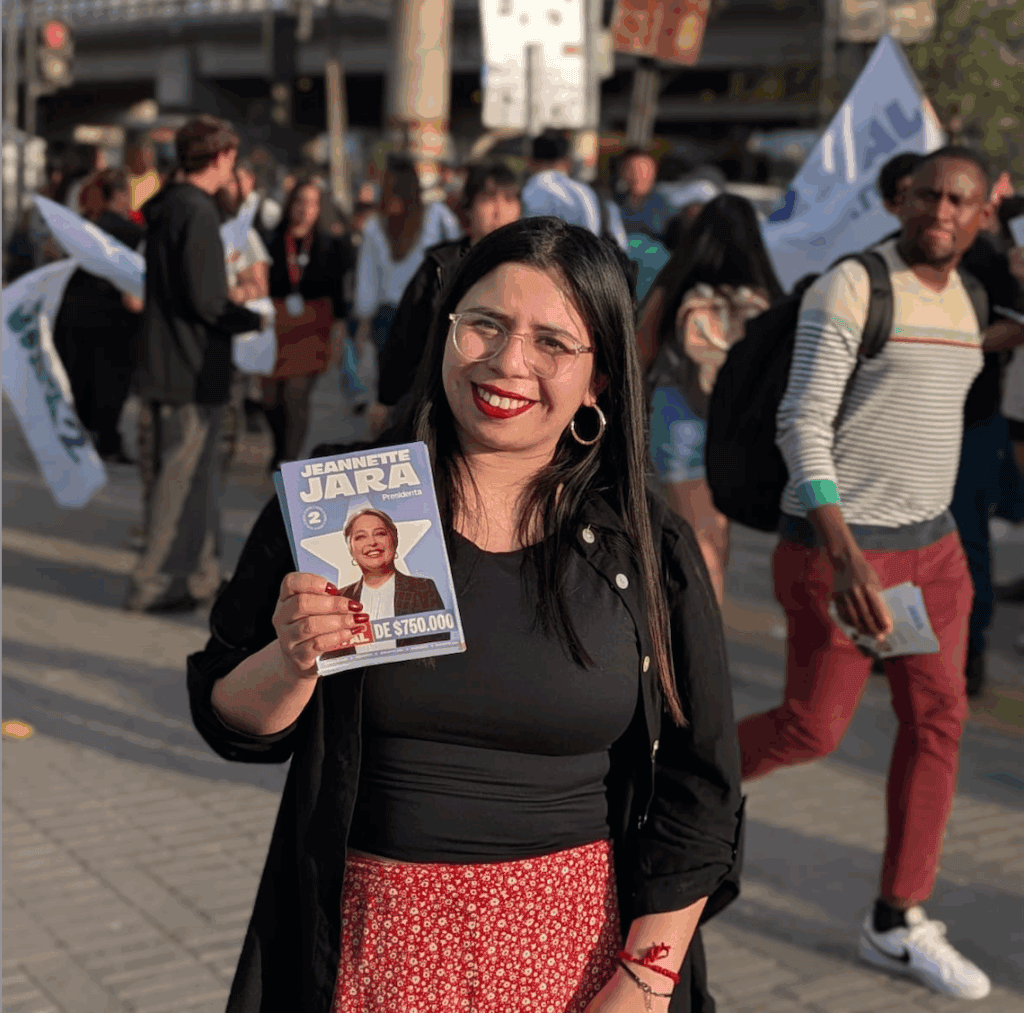
Jara’s campaign, which has adopted a simple, direct tone and a penchant for snappy social media posts that draw on manga imagery and viral dance trends, has helped to soften the party’s image. So too has the rise to prominence of other young and fresh female faces, including lawmakers Karol Cariola and Camila Vallejo. Cariola, now 39, and Vallejo, 38, were both elected as deputies on Communist Party platforms in 2013, winning parliamentary seats on the back of an initial wave of student protests that took aim at bread-and-butter cost-of-living issues. When, in 2019, this movement again exploded into the streets of Chile—propelling student activist Gabriel Boric and his governing coalition Apruebo Dignidad to power— Cariola and Vallejo took on bigger, more visible roles in the new government. Vallejo served as government spokesperson, Cariola as director of the National Women’s Service.
Though Boric was not himself a communist, his ascension to power brought the PCCh back into the fold for the first time in decades. Indeed, the party was not included in the center-left coalition known as La Concertación, which helped transition Chile back to a democratic system. It was also excluded from the center-left and center-right governing coalitions that followed.
A Party Reborn?
The party has weathered difficult moments before in its long history. Founded out of the trade union movement in Chile’s northern desert in 1912 as the Socialist Workers’ Party, it was renamed the Communist Party a decade later. Since its founding, the party has been banned three times. During the dictatorship of Augusto Pinochet, hundreds of party members were killed or disappeared, and many members of its central committee were forced into hiding or exile.
According to Rolando Álvarez Vallejos, a historian whose research focuses on the Chilean left and, in particular, the PCCh, this new generation of lawmakers and activists has revived the party at a moment when it was struggling to stay alive as a political force. Now, it is on the cusp of victory. “This is a generation that is involved in politics in order to get elected, not to hold the flag,” explains Álvarez.
Central to its newfound appeal was its shedding of its old reputation as a “boys-club”—a transition that has not been without hiccups. In January 2017, the leadership of La Jota sought to enshrine feminism as a fundamental party principle. The initiative was met by intense internal resistance, with party leaders decrying “bourgeois” tendencies, Álvarez notes. Several years later, in 2021, the young leaders brought the same debate to the central committee. Despite resistance, they were able to win the battle and in 2022, the Chilean Communist Party embraced an overtly feminist party line.
This new generation of lawmakers and activists has revived the party at a moment when it was struggling to stay alive as a political force.
“It’s a party where the caciques, the internal bosses, have ruled, and where women have historically played a rather secondary role. Even though there are many communist women, it has historically been a much more male-dominated party,” explains Claudia Heiss, a politics professor at the University of Chile. “And I think that along with this change, in a way, there’s also rethinking the international dynamics of what it means to be a communist.” This has shown through in the party’s foreign policy choices, which have shifted away from traditional PCCh allies accused of human rights violations. “I don’t see Karol Cariola or Camila Vallejo sending birthday greetings to Kim Jong Un,” Heiss adds with a smile.
Still, even as some in the party have drifted toward a more democratic socialist vision, Lautaro Carmona—the president of the Chilean Communist Party—insists that it must remain committed to its proletarian foundations and transformative vision of class politics. “The Communist Party is a class-based party. And here, beyond age, what matters is one’s class position,” Carmona says from his office in Santiago, which is decorated with party propaganda from the Soviet Union, China, and Vietnam.
A “Path of Hope”
It hasn’t only been youngsters breathing new life into the party. In total, 28 communist candidates are running for office in the upcoming elections, whose first round is scheduled for November 16. The youngest, Daniela Serrano, is 30 years old. The oldest, Carmen Hertz, is pushing 80. In Antofagasta, early childhood educator Paulina Lizana, 59, didn’t join the Communist Party until 2020. “I think I was always communist, I just didn’t know it because I didn’t grow up in that environment,” Lizana said.
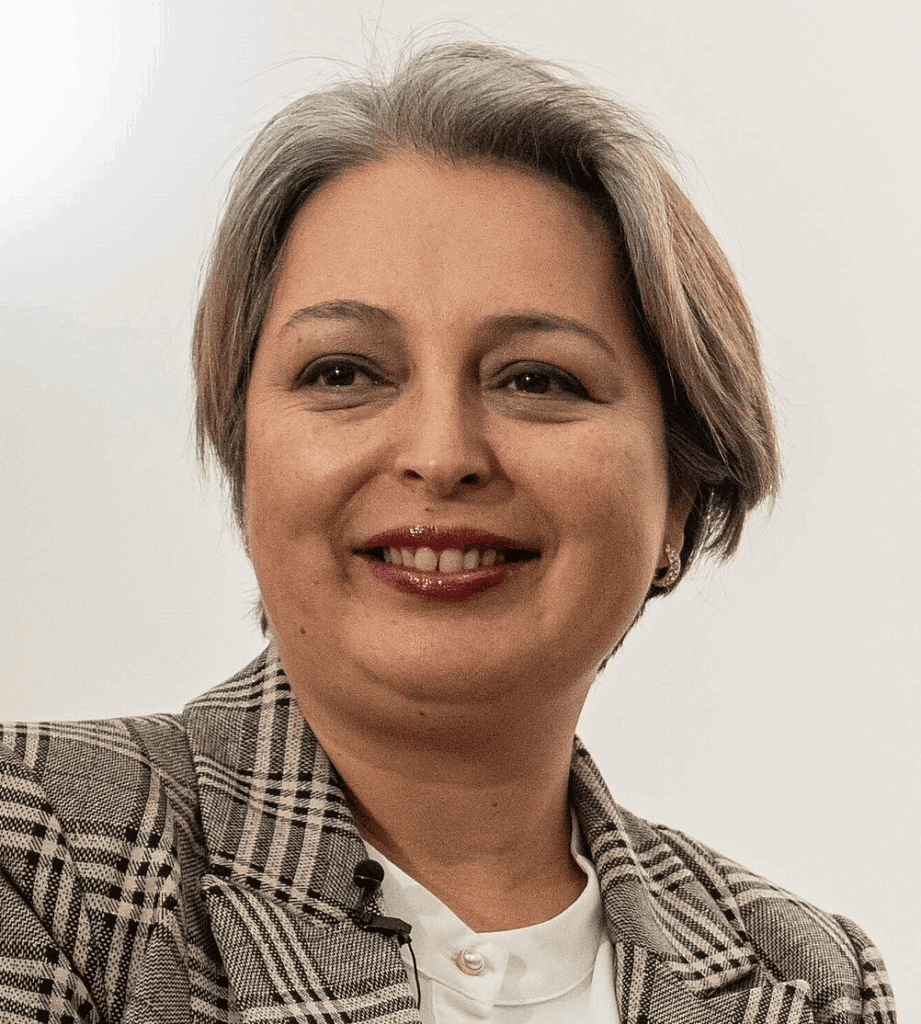
After anti-government protests were violently repressed in her neighborhood, Lizana joined the party and in 2025 was tapped to run for Chile’s third district, representing a vast swath of the country’s copper mining region. Seeing young women like Carmona and Vallejo take on important roles in the party, Lizana says, helped her gain confidence. “They’re part of the reason why we say communist with more strength.”
Hassler, in Santiago, agreed: “I think people have gotten to know us better, and that has been greatly influenced by the fact that today we have the support of people who consider themselves progressive leftists and even those who do not have a clear political position, but believe in social rights. Today, they support Jeannette Jara, and they also support our candidacy. So I hope that we can move forward and succeed in defending a more just society.”
The task won’t be easy. Even if Jara gets the highest number of votes in the first round of the elections, polls show her losing in the second round, regardless of the candidate she runs against.
But to some, Jara’s campaign has already served its purpose. For Angela Rifo, a labor union leader who was detained and tortured during the dictatorship, Jara’s candidacy is historic: “I think it opens up tremendous possibilities for the future, not only because she’s a woman, but also because it shows that a person like us, a worker, a former union member, a woman from a poor neighborhood…can be chosen to be the head of state of this country,” she said. “I think that’s very important for hope, especially for the youngest among us. I believe that her run, regardless of the results, opens a path of hope at a tremendously complex time in the world.”
Phineas Rueckert is a Paris-based journalist whose work has appeared in The Guardian, Le Monde, New Lines Magazine, The Dial and other outlets. He has reported from Mexico, Colombia, Chile, Paraguay and Argentina.