

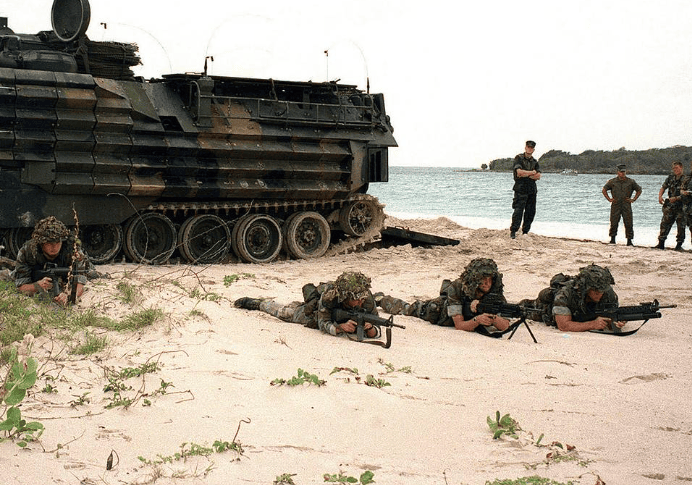
The small town of Arroyo, Puerto Rico, where U.S. military troops invaded the archipelago during the Spanish-American War in 1898, is once again the site of U.S. military “operations.” The United States has been deploying fighter jets, amphibious vessels, and large warships to Arroyo as part of a military buildup in the Caribbean. Arroyo is just over 30 kilometers west of Yabucoa, where Hurricane María made landfall in 2017 and exposed the entangled lethality of colonialism, extractivism, and energy injustice.
What do these two instances of U.S. imperial violence, 128 years apart, have in common? They illuminate the ongoing exploitation and extermination of life—human and more-than-human, on the archipelago. As Puerto Ricans fight to survive climate and energy injustices as a U.S. colony, current militarization inflicts harm and impedes the co-creation of a self-determined, just-energy future.
Now, with hurricane season well underway and storms becoming increasingly severe every year, communities are sounding the alarm. Instead of military occupation and pollution, Puerto Ricans need urgent access to solar systems near the point of use at affordable prices to minimize life-threatening interruptions in power.
Militarization Intensifies Environmental and Energy Injustice
The U.S. military is the largest polluter and greenhouse gas emitter on Earth. For decades, Puerto Ricans have resisted U.S. military occupation by exposing the link between occupation and environmental injustice. From 1999 to 2003, Puerto Rican residents fought the toxic military assault in Vieques by the U.S. Navy, leading to its eventual expulsion. Residents continue to live with and die from the impacts of poisoning, while navigating a lack of access to healthcare, decent work, and healthy food. Despite their struggles, Vieques residents consistently demonstrate the power of solidarity and intersectional movement-building efforts.
More than two decades later, the governor of Puerto Rico, Jenniffer González, her chief security officer, Arthur Garffur, and the president of the Puerto Rico Senate, Thomas Rivera Schatz, have welcomed the U.S. military buildup as an opportunity for economic development, despite fueling the military’s activities with fossil-derived energy and further exacerbating environmental racism in Puerto Rico.
In towns like Salinas, the lead-up to the U.S. involvement in World War II resulted in the displacement of civilian communities to build a military base that occupies one-third of the municipality’s land. Interviews conducted by Ruth Santiago with Salinas residents in the late 1980s recounted how U.S. military maneuvers with live munitions maimed and killed residents already displaced from their agrarian livelihoods.
The rebuilding and expansion of the Army National Guard’s installations in Salinas threatens drinking water supplies for the municipality’s nearly 30,000 residents.
The U.S. military has polluted land, freshwater sources, and marine ecosystems throughout the archipelago for decades. Most recently, the rebuilding and expansion of the Army National Guard’s installations in Salinas threatens drinking water supplies for the municipality’s nearly 30,000 residents. It may also cause increased flooding in the town center and nearby communities, compounding the concentration and exposure to volatile chemicals. Salinas-Guayama is an energy sacrifice zone for two of Puerto Rico’s largest polluters, the Applied Energy Services (AES) coal-fired power plant and the Aguirre Power Complex. Meanwhile, the region’s residents confront barriers to equitable electricity access.
Access to Rooftop Solar Out of Reach
According to a study by the National Renewable Energy Laboratory, rooftop solar systems reduce or eliminate the need for transmission because the energy is generated at or near the point of use. However, their high cost makes them inaccessible to most Puerto Ricans, deepening energy segregation.
Only a small portion of the population can afford the inflated costs of rooftop solar equipment and batteries, financed by irreputable companies like Sunnova, which have engaged in documented predatory practices. Net-metering, a billing program that credits households that generate excess rooftop solar that contributes to the grid, allows rooftop solar households to recover a portion of their equipment costs. However, these households are exempt from making payments to the Puerto Rico Electric Power Authority (PREPA). Instead, these utility costs are passed along to households that cannot afford to install or access rooftop solar systems where they live.
On July 31, 2025, the Puerto Rico Energy Bureau (PREB) exempted net-metering customers from paying for the pensions of PREPA, the public utility workforce, thereby transferring their portion of the payment to customers who do not have the privilege of owning or leasing rooftop solar systems and participating in net-metering. The policy deepened energy segregation on an archipelago where the poverty rate is three times greater than in the United States. PREB should not favor people with greater purchasing power over most of the population.
The policy deepened energy segregation on an archipelago where the poverty rate is three times greater than in the United States.
Access to an uninterrupted and solar-powered energy supply at the point of use in Puerto Rico has become a privilege for higher-income households. A manifestation of energy privilege, residents with higher incomes, who tend to be whiter, have access to a more stable energy supply, while most of the population struggles with grid instability and constant power outages. In low-wealth communities and in municipalities that are largely home to Afro-descendant and Black residents, families often depend on generators, paying for fuel and inhaling poisonous fumes, while being exposed to noxious sound pollution.
The Government of Puerto Rico plans to continue increasing payments to fossil fuel corporations and the industry’s power infrastructure. These payments are required by LUMA, GENERA, the company that operates the generation plants, and New Fortress Energy (NFE), Genera’s parent company that sells fuel for the plants. In mid-September, NFE signed a $4-billion deal with the Puerto Rican government, further locking the archipelago into liquefied methane gas reliance. AES in Guayama is also expected to reap billions from residents. Additionally, the growing problem of improperly-sited utility-scale solar projects advances green racial capitalism and is literally and figuratively flooding southern coastal communities.

Toward an Energy-Just Horizon that Refuses Militarization
In August 2025, Hurricane Erin missed Puerto Rico by about 200 miles. The storm still resulted in blackouts, leaving more than 160,000 electricity customers in the dark for days. Meanwhile, widespread calls for LUMA Energy to be removed from operating and maintaining the electrical grid continue. Given the threat of hurricanes making landfall, the Puerto Rican government must have a disaster mitigation plan, as well as an electrical system that guarantees access to reliable, decentralized, and affordable renewable energy for all residents.
Given the fragility of the centralized, fossil-powered electrical grid, it is imperative to implement technical and political transformations toward an electrical system with full access to distributed renewable energy for everyone in Puerto Rico. The LUMA partnership must be abolished, and PREPA must provide full access to distributed solar energy, using disaster recovery and mitigation funds to supply the population with rooftop solar systems and batteries. Disaster recovery and mitigation funds should be used to install solar systems on rooftops and over parking lots. Residences, businesses, industries, and institutions, including schools and water purification and treatment infrastructure facilities, are all crucial on-site generation spaces.
Puerto Rican residents also need direct access to and autonomy in guiding non-debt-creating solar community project funds. Just transition efforts must support local renewable energy job pathways toward a regenerative economy, as well as fund energy efficiency, storage, demand management, and popular education programs. As frontline workers and community members fill New York City streets this week—insisting “Make Billionaires Pay!”—calculations by Oil Change International show there are ample public funds to advance climate action. Taxing the rich, defunding war, practicing debt justice, ensuring corporations fairly pay taxes, and making polluters pay for their environmental crimes are necessities for funding energy justice.
With increasingly destructive storms, an energy-just transition is not only about equity, but also life and death.
Civil society proposals for PREPA to recover the operation and maintenance of transmission, distribution, and generation of energy, as well as other functions of the electrical system, are gaining traction. Support continues to grow for PREPA to focus on the public interest and wrest control from for-profit corporations and dominant political parties. The public interest requires the full participation and direct involvement of various sectors of civil society in decisions regarding the electricity system, including representatives of energy actors, or “ratepayers,” communities near the main electricity infrastructure, and people knowledgeable in distributed renewable electricity systems.
With increasingly destructive storms, an energy-just transition is not only about equity, but also life and death. Everyone in Puerto Rico deserves access to affordable solar systems near the point of use to minimize life-threatening interruptions and to create livelihoods for community members in the energy sector. These conditions are essential for “making livable worlds” that reject occupation, “energy dominance,” and the ongoing violence of the U.S.’s militarization and colonial control of Puerto Rico and beyond.
Ruth Santiago is an environmental justice and community attorney who lives and works in Salinas, Puerto Rico.
Catalina de Onís dedicates her writing, teaching, and organizing to multimodal projects and collaborations committed to just worldmaking.
Hilda Lloréns advocates, writes, and teaches about environmental and social justice.